Views: 0 Author: Site Editor Publish Time: 2026-05-21 Origin: Site
The transition of synthetic turf from basic aesthetic replacements to highly engineered, performance-driven surfaces requires precise polymer science. You can no longer rely on outdated manufacturing methods. In modern Artificial Grass Yarn Production, manual or semi-automated processes introduce severe micro-variations. Temperature fluctuations, uneven tension, and poor chemical mixing compromise the final product. These flaws directly weaken the durability and UV resilience of the synthetic grass. End-users suffer when installations degrade prematurely.
We see high automation solving these critical operational issues entirely. It is no longer a luxury for manufacturers today. Instead, it serves as the baseline requirement for producing consistent, high-tensile yarn. Such precision easily meets strict commercial and athletic durability standards. In this article, you will learn how automated production lines eliminate weak points and secure dimensional stability. We will explore core extrusion technologies, system-level durability benefits, and vital operational economics. You will also discover a practical framework to properly evaluate a vendor's manufacturing capabilities.
Automated gravimetric dosing ensures precise polymer, colorant, and UV stabilizer ratios, eliminating weak points in the yarn.
High automation reduces coating and extrusion variance (often to ≤0.1mm), directly impacting the yarn's dimensional stability and tuft-bind strength.
Advanced winding and texturizing technologies minimize human error, reduce labor costs by up to 30%, and allow for rapid, seamless changeovers.
Evaluating a manufacturer’s level of automation is a reliable proxy for forecasting product lifespan and batch-to-batch consistency.
Artificial grass yarn relies heavily on specific synthetic polymers. Polyethylene provides unmatched softness for landscape surfaces. Polypropylene ensures excellent UV resistance for exposed areas. Nylon handles high-traffic wear gracefully in athletic fields. Legacy mixing methods struggle to blend these materials perfectly. They often distribute these raw materials unevenly throughout the batch. This uneven distribution creates weak zones inside the extruded fibers. When sunlight and foot traffic hit these weak zones, the fibers snap or fade quickly.
Complex 3D blade shapes demand perfection during extrusion. Shapes like "W", "C", or Omega profiles do crucial work. They diffuse intense light to reduce artificial glare. They also provide vital structural memory so the grass springs back after compression. These complex designs require exact die-plate extrusion tolerances. Manual monitoring fails repeatedly in this environment. Operators cannot detect microscopic die degradation quickly enough. When die plates wear down unevenly, the yarn geometry changes instantly.
These upstream errors trigger severe downstream consequences. Inconsistent yarn thickness causes irregular tufting behavior. The needles jam or misalign during the backing process. You see poor stitch rates and variable tuft-lock strength across the same roll of turf. Ultimately, this reduces the operational lifespan of the installation. A projected 10 to 15 years of usability drops to less than five. Buyers face early replacement cycles and intense frustration.
Manufacturing Stage | Legacy Manual Process | Automated Process | Downstream Turf Impact |
|---|---|---|---|
Polymer Mixing | Volumetric estimation by operators | Gravimetric dosing via PLC | Eliminates weak spots; uniform UV resistance. |
Die Extrusion | Visual spot-checks for shape | Continuous sensor monitoring | Maintains 3D blade structural memory. |
Yarn Tension | Manual bobbin swaps causing drops | Automatic high-speed swaps | Prevents skipped stitches during tufting. |
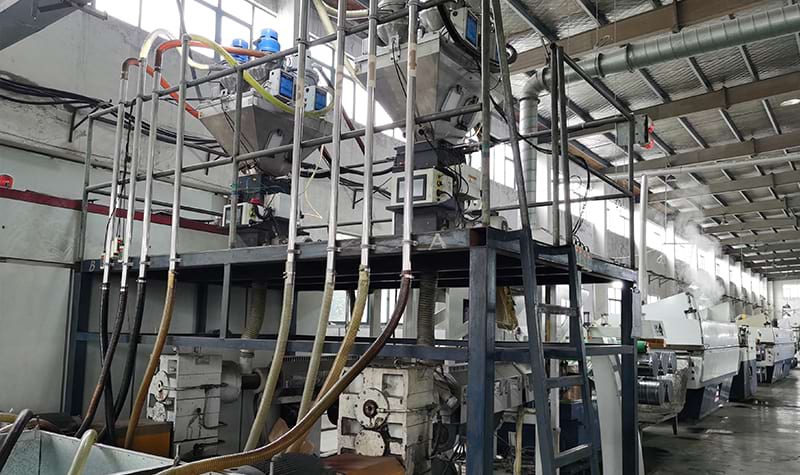
Precision extrusion and gravimetric dosing form the foundation of modern manufacturing. Facilities utilize networked PLC (Programmable Logic Controller) systems today. These systems manage continuous weight-loss dosing effortlessly. They ensure the exact ratio of masterbatch, UV inhibitors, and base polymers enters the extruder. In modern Artificial Grass Yarn Production, this eliminates human measurement errors. The polymer melt stays perfectly consistent from the first meter to the last.
Automated stretching, annealing, and quenching define the physical strength of the grass. The yarn must pass through advanced air and water mix ovens. The machinery maintains absolute temperature stability during this phase. This precision locks in the yarn’s tensile strength. It achieves the desired softness without inducing thermal stress. If temperatures fluctuate even slightly, the polymer chains fail to align. Automated ovens prevent this molecular failure entirely.
Air texturizing and automated winding handle the final physical formatting. Facilities process high-dtex yarns seamlessly. Yarns reaching up to 20,000 dtex pass through automated air texturizing units. This creates natural-looking thatch layers that mimic real grass roots. Continuous output needs flawless handling. Automatic bobbin swaps occur at maximum line speeds. This prevents sudden tension drops. Implementing this level of High Automation ensures the tufting machines receive perfectly wound spools.
Rapid changeover mechanisms keep factories highly agile. Automated lines switch configurations rapidly. They can move from fibrillated tape to monofilament production in under 30 minutes. Digital molds and pre-programmed settings handle the transition. This drastically reduces downtime and material waste. Manufacturers fulfill diverse orders without sacrificing their production schedules.
High-quality synthetic grass acts as a complete interlocking system. The yarn, backing, and coating work together intimately. They are not isolated components. Systematic quality integration matters immensely. Automated yarn consistency serves as the absolute prerequisite for downstream success. If the yarn varies in thickness, the strongest backing glue will still fail. The entire system relies on the initial extrusion accuracy.
Optimizing the tufting and backing phases requires uniform materials. Precision-extruded yarn feeds incredibly smoothly into double-servo tufting machines. These machines operate at extreme speeds. Accurate yarn geometry ensures accurate gauge and stitch rates. The needles do not bend or skip stitches. The resulting turf roll maintains a dense, even surface profile. This directly prevents bald spots or uneven wear patterns.
Adhesion tolerances dictate how long the grass stays intact. Uniform yarn profiles allow for highly automated backing applications. Factories apply Polyurethane (PU) or latex coatings with micron-level accuracy. The variance stays at or below 0.1mm consistently. This precision secures a superior filament bond known as tuft lock. A highly uniform tuft lock withstands thousands of pounds of pull-force. Athletes can pivot aggressively on the surface without tearing the fibers out.
Coating Type | Optimal Variance Target | Automated Precision Outcome | Primary Benefit |
|---|---|---|---|
Polyurethane (PU) | ≤ 0.1 mm | Ultra-secure filament bond | Superior moisture and pull resistance. |
Latex Base | ≤ 0.15 mm | Consistent base layer weight | Cost-effective structural stability. |
Buyers often wonder why factory-level technology impacts their purchasing decisions. Automated production systems directly benefit B2B buyers through several key economic advantages. They shift the financial focus from overhead to material quality.
Cost Control via Efficiency: Automated production lines cut energy consumption by up to 20%. Human labor requirements drop by roughly 30%. These impressive efficiencies allow manufacturers to reallocate funds. They invest more capital into premium raw materials. They purchase aerospace-grade polymers rather than funding high operational overhead.
Scalability & Lead Times: Large projects demand massive volume. High-capacity automated setups yield 5,000 to 10,000 square meters daily. Annually, these lines produce 600 to 3500 tons of turf. This immense output guarantees stable supply chains for B2B buyers and global distributors. Projects do not stall due to material shortages.
Batch-to-Batch Consistency: Phased commercial installations take months to complete. Automated tracking ensures perfect matching across time. An order placed six months later perfectly matches the original batch. The color profile, UV resistance, and blade resilience align flawlessly. Manual blending simply cannot guarantee this exactness.
Because High Automation streamlines the supply chain, buyers face fewer delays. They receive superior products without absorbing the costs of factory inefficiencies. The economic advantage trickles down directly to the end-user's installation quality.
Choosing the right manufacturing partner requires diligent technical assessment. You cannot rely solely on marketing brochures. You should evaluate vendors using a structured framework. This protects your investment and ensures high-performance delivery. We recommend auditing vendors against three specific criteria.
Audit Criteria 1: Equipment Specifications. Look closely at the high-grade machinery components inside their factory. Ask about their extrusion hardware. The presence of 38CrMoALA steel screws for extrusion indicates serious quality. Hard-tooth surface reducers suggest a robust, low-vibration automated line. Low vibration prevents microscopic ripples in the yarn.
Audit Criteria 2: In-line Quality Control. Question their monitoring protocols. Does the manufacturer utilize automated, continuous monitoring? Do laser sensors check yarn denier and dtex consistency in real-time? If they rely solely on post-production manual spot-checks, walk away. Manual checks only catch errors after kilometers of defective yarn exist.
Audit Criteria 3: Turnkey Integration. Assess the holistic communication of the factory floor. Does the extrusion line seamlessly communicate with the texturizing phase? Segmented, disconnected machinery often introduces severe tension faults. The seamless nature of High Automation prevents these physical disconnects. Integrated platforms share data instantly to adjust speeds dynamically.
Using this framework removes guesswork. It reveals exactly how a manufacturer handles complex polymer processing. It separates genuine engineering firms from basic assembly workshops.
High automation in artificial grass yarn production drastically shifts the manufacturing landscape. It moves the process away from reactive quality control toward proactive precision engineering. You no longer have to hope the batch comes out right. The machinery guarantees it.
For distributors, facility managers, and B2B buyers, your strategic stance matters. Partnering with highly automated manufacturers severely mitigates your supply chain risks. It ensures consistent system-level durability across massive orders. Ultimately, this protects your long-term investment value and enhances your brand reputation in the market.
Take immediate action during your next procurement cycle. Recommend requesting comprehensive technical specification sheets (TDS) from all potential vendors. Scrutinize their stated tolerance margins closely. Demand transparent equipment automation audits during the vendor shortlisting process. Demand excellence from the ground up.
A: No. Advanced automated lines use digital PLC controls that allow for rapid mold and setting changes. These shifts often happen under 30 minutes. This technology enables high flexibility across blade shapes, colors, and pile heights. Manufacturers achieve this extreme customizability without sacrificing precision.
A: Automation utilizes highly precise gravimetric dosing systems. This ensures UV stabilizers are uniformly integrated into the polymer mix during the extrusion process. It prevents the random weak spots that cause premature fading and fiber brittleness under harsh sunlight.
A: Automatic bobbin swapping at high speeds ensures perfectly consistent tension throughout the yarn spool. Manual interventions often cause sudden tension drops. These fluctuations lead directly to irregular feeding and skipped stitches during the downstream tufting process.